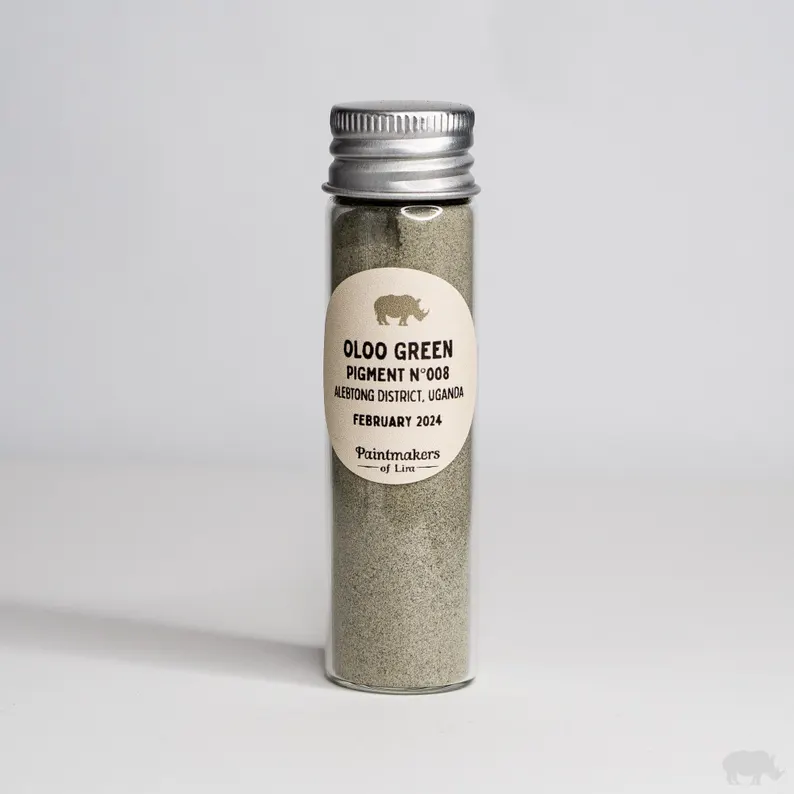
Natural Earth Pigment(N° 008, Edition: February 2024)Alebtong District, Uganda
According to Imat Erine (a village elder and farmer), the potters in believe the green clay is a premature form of the cream clay, and a pot made with green clay will be weak. They prefer to wait for the green clay to mature into cream. However, the green is most likely colored by glauconite, and it will not “mature” into cream clay.
This pigment is hard to find, and our source floods during the rainy season. It is found in small, finger-sized patches on a river bank, mixed in with a lighter clays. We have only a small amount on hand.
Oloo Green pigment can separated into more colors with levigation: a light brownish green, a darker green, and a chalky green. The color is subtle and transparent. Do not expect a rich, leafy green!
(“Oloo” is pronounced “Oh-low”)
(Oloo Green: 10 ml = 10 g; 20 ml = 20 g; 35 ml = 35 g; sample = 2 g)