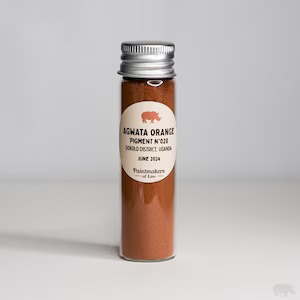
Natural Earth Pigment(N° 028, Edition: June 2024) Dokolo District, Uganda
Agwata Orange is a rich, bright, warm orange color — definitely one of our favorite colors.
Fortunately, we have some kilograms in storage, because foraging for this color is now difficult. We had no trouble the first few times, but the last visit did not work out very well.
When we arrived in Agwata, a man wearing a bright yellow t-shirt with President Museveni’s face on it stopped us on the road. His companion carried a spear with sharp tines instead of a traditional spearhead. After some discussion between Sharon, Dan, and the men, we learned that there was a funeral taking place and the community security team was present. Dan showed them a letter from the mayor as proof of our mission, and after some convincing (he made sure to mention his background as a police officer), they allowed us to continue but instructed us to stop at the nearby trees and not go further.
The village elders agreed to accompany us to see the traditional colors, but some locals who were angry about our presence approached us (as Sharon had predicted based on their experiences in Ongica). We were in a truck, rented to us by a local NGO. To the villagers, this meant that someone should be paying money, and they were also worried about the government (or someone) taking their land.
They threatened to attack or burn our truck. Then, a man from the sub-county arrived and in a commanding tone told us to go to his office because we had gone to the wrong people without informing higher authorities first. We followed him to the sub-county office where we sat in a circle with other important officials.
Eventually, the officials got down to business and informed us that if we wanted to obtain colors, we would have to pay a fee of UGX 150,000 plus additional fees for police, local security, and others (about UGX 10,000 each group). They also added that we would have to pay for the actual colors themselves (price unspecified).
We listened attentively and I asked what if we didn’t want to take any colors but rather train some of their young people to gather them for us? They liked that idea but still insisted on the initial fee.
Sharon said she would have to consult with the NGO that owned the truck to see if they could cover the cost. We thanked them and left, and in the truck, the team expressed annoyance but also slight amusement. They were not willing to pay such a large sum of money to corrupt officials. They explained that in Oloo and other places, people usually request a more reasonable payment rather than 150,000. Additionally, they believed that even if we paid this time, the next official we encountered would demand another sum even though our paperwork was already on file. They concluded that these officials were only after money for themselves and not for the villagers. Lastly, they warned me that we couldn’t even try to negotiate with the locals because once word got out, everyone would come demanding payment, and it was better to avoid any conflict altogether.
(Agwata Orange: 20 ml = 20 g; 35 ml = 35 g; 55 ml = 50 g; sample = 2 g)