
At Paintmakers of Lira, Our Pigments are 100% handmade, carefully sourced from the earth, plants in the local villages and within our communities. We process them to bring out the rich, natural color. Each pigment carries its own story from raw material to refined powder ready for making paints.
Charcoal Black – P020
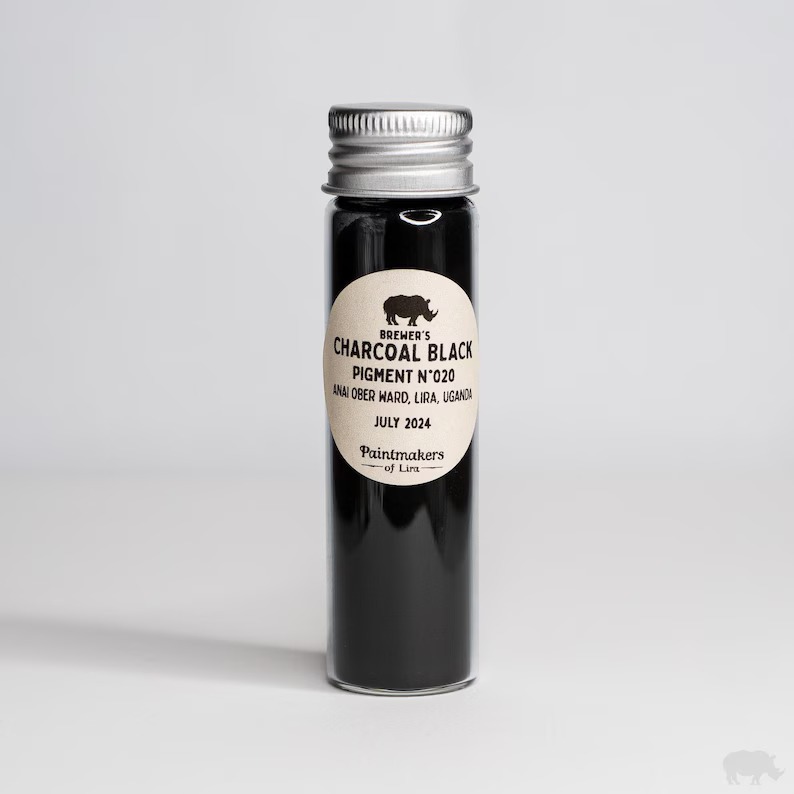
In Sharon’s neighborhood in Lira, local brewers use small fires to make drinks like ajon and waragi. When they are done, the fires leave behind charcoal.
We collect this charcoal and use it to make our carbon black pigment. It is very light, but the color is deep and strong. It also mixes easily with gum arabic, so it works well for making paint.
In these areas, many brewers are women working from simple setups at home. They use ingredients like millet, cassava, or bananas, and the skills have been passed down over time. Brewing helps them earn money and support their families.
The work is informal, but it is important in the community. People buy the drinks, spend time together, and connect with each other.
From this everyday work, we get the charcoal we need. What is left after brewing becomes a useful material for our pigment.
Oloo Green -P036
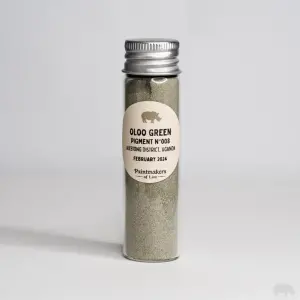
This is an earthy green that was discovered from the banks of Oloo River located in Oloo village in Lira. Many people from that village fetch that water for various domestic uses like cooking, laying bricks, pottery and they also use the underground clay from the river for smearing traditional walls.
We took a trip to Oloo but what we did not understand is that sometimes, it is hard to find the pigment because the river floods during rainy season. It is found in small, finger-sized patches on a river bank, mixed with lighter clays. According to the potters in the village, the green clay is a premature form of the cream clay, and a pot made with green clay will be weak. They prefer to wait for the green clay to mature into cream. However, the green is most likely colored by glauconite and it will not “mature” into cream clay.
We have also taught the local community including the young children on how to remove earth colors carefully and they really loved it. For us to get that nice green, we also mind being very careful back at the studio when washing and levigating to ensure the green is distinct.
Oloo Green pigment can be separated into more colors with levigation: a light brownish green, a darker green, and a chalky green. The color is subtle and transparent. We usually want people to be informed that they should not expect a rich, leafy green.
Bala Maroon
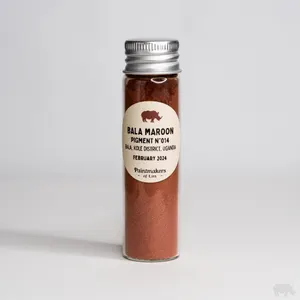
The land where we found this color is rocky, with two beautiful colors of maroon and orange. It is hot with less trees, and the source can be spotted from the road side. This “maroon” clay is used as a concrete for houses and for road construction. According to a local farmer, Steven Otuk, this clay site was discovered by road contractors who find it a good clay for road construction. The raw clay looks maroon, and it is found next to orange clay. Separating the two is practically impossible, so the final processed pigment has a little more orange the we hope for.
Agege Cream
On our way back after collecting Bala Maroon, we came across this interesting and unexpected cream. Near a borehole in Agege village, Bala Sub-county, we noticed a beautiful cream-colored soil that had been brought to the surface during some repair work on the borehole.
The soil immediately caught our attention because of its soft and natural color. It looked very clean and unique, and we felt it was something worth keeping. After taking some time to look at it closely, we decided to collect some of it.
Since we did not have anything to carry it in at that moment, we went to a nearby trading center and bought a sack. We then carefully filled the sack with the cream-colored soil and made sure it was well packed and safe for transportation.
What seemed like a simple and small discovery at that time later became very important, as this same soil turned out to be the beginning and main source of what we now call our Agege cream.
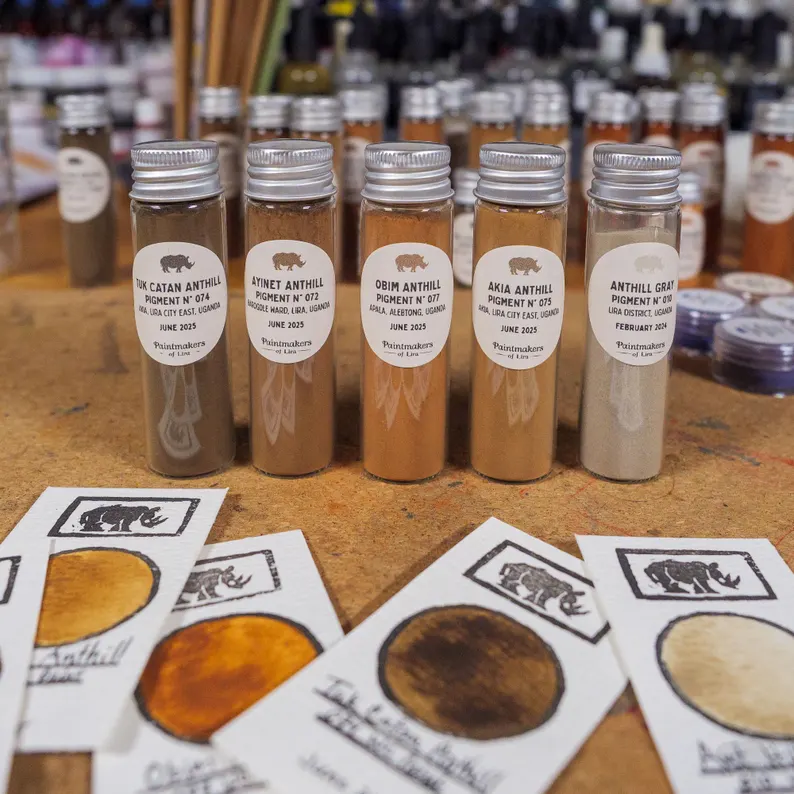
The Anthill Colors
Apac Anthill Grey – P010
This shade of grey was discovered by Nancy (team member) one morning. She had visited their village, in Apac and on her way back from the well, she saw an anthill that was grey in color near a well (known as “Biasara”) in Apac Municipality, Kwania District. Grey anthills are not common. It is said that most of the grey anthills are found in swampy areas. According to the villagers, this anthill Grey is used traditionally to paint huts, to decorate walls during festive seasons, and for making bricks.
AYINET Anthill – P072
AYINET Anthill is a medium brown that we discovered right outside our studio in Lira City. This anthill is a source of edible white ants, and it is also a hiding place for bush animals like giant rats (known as “Obaa”). Traditionally, only men are allowed to eat the ants. The anthill had built itself inside the AYINET compound for years. We named it “AYINET Anthill” because that’s where we discovered it. This brown anthill color traditionally is used in villages for painting huts and walls.
Tuk Catan Anthill – P074
Tuk Catan is a transparent umber color, very beautiful and good when used in paintings. It was found on Akia hill in Akia village, Lira City East Division. These anthills are small and short, and commonly found in forests, hills, and swamps. The name “Catan” is a local word that comes from the word “Satan,” and some people believe that these anthills are made by the devil, and as children, we feared it so much and were warned to stay away. Collecting it now shows how much strength and courage we have gained over the years.
Akia Anthill – P075
Akia Anthill is a light, transparent brown that we discovered on an anthill on Akia Hill, in Akia village, Lira East Division. The team had been contracted as make-up artists for a movie being shot on the hill. During a break, Sharon took a short walk around and spotted this anthill. She collected a small amount and brought it back to the studio to make a pigment from it.
Obim Anthill – P077
Obim anthill color is a warm, brownish orange color that can be used to paint the human skin color in paintings. This anthill color was found on Obim hill in Apala Sub–county, Alebtong District, about 15km away from Lira City. It was literally an anthill on a hill. The team of Halmon and Dan took a trip to Obim to forage for colors. They climbed up Obim hill to source for the earth colors, and that is how they spotted the anthill, though they never expected to find anything special. Now, it’s part of our beautiful anthill colors.
Atuk Brown- P031
Atuk brown is part of the soot color collection. Sharon and the team discovered it at Hellen’s home in Anai Ober, Lira City West, while they were out looking for soot colors.
Hellen cooks in a grass-thatched house using firewood, which makes it very easy for “Atuk” to form. The soot slowly builds up when fire is set inside the house the smoke rises, settles, and thickens over time.
Curious, they picked it and sampled it. The process to prepare it is simple but intentional: wash it, let it dry, then grind it into a usable pigment.
Traditionally, this soot has been valued for many purposes, especially mothers use it after birth for curing the umbilical cord, and even today, many people still visit Hellen to collect the Atuk and continue to use it for that same purpose.
Some people still ask questions on how the Atuk really is the cure for the Umbilical cord, but there’s a lot to tradition that the elders do know.
In modern homes, however, many people see Atuk as dirty and unwanted. But Hellen was genuinely happy to learn about its potential from Paintmakers of lira. She realized that instead of being wasted, Atuk could be preserved and shared with Paintmakers of Lira.
Sometimes the soot is very dusty, which is why washing is important. At first, it may look deep black, but after washing, it transforms into a rich, warm brown a beautiful color. Sharon and the team were specifically searching for soot-based colors, and that’s how Atuk brown became part of the collection.
Brewer’s Charcoal Black- P020
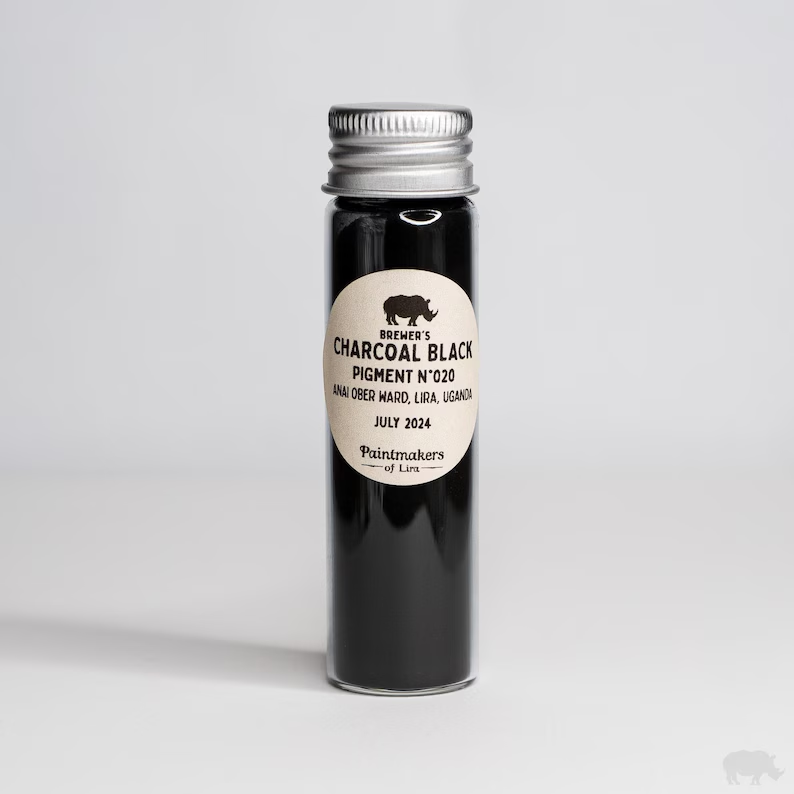
This is a carbon black pigment made from the charcoal from the fires of local brewers in Sharon’s neighborhood in Lira. The pigment is very light in weight, but rich and intense. (Also, we have no trouble mixing it with gum arabic to make paint).
In the poorer neighborhoods of Lira, Uganda, local alcohol brewers play a significant role in the community’s daily life. These brewers, often working out of small, makeshift setups, produce traditional alcoholic beverages like “ajon” or “waragi,” which are popular among the locals. Brewing is usually done using basic ingredients like millet, cassava, or bananas, and the process is passed down through generations.
For many families, brewing is more than just a tradition it’s a vital source of income in an area where job opportunities are scarce. The brewers are often women who manage both the brewing and selling, creating a small but essential business that helps support their households.
However, this local industry operates in a bit of a gray area. The brewing is mostly informal, with little regulation, which means that the quality and safety of the alcohol can vary. Despite this, these brewers are respected in their communities for their skill and for providing an affordable drink that brings people together in social settings. Whether it’s a gathering at a local bar or a casual chat among neighbors, these traditional brews are a staple of life in Lira’s poorer neighborhoods, reflecting both the resilience and the ingenuity of the people who make them.
Imat Lango Cooking Stone Red- P076
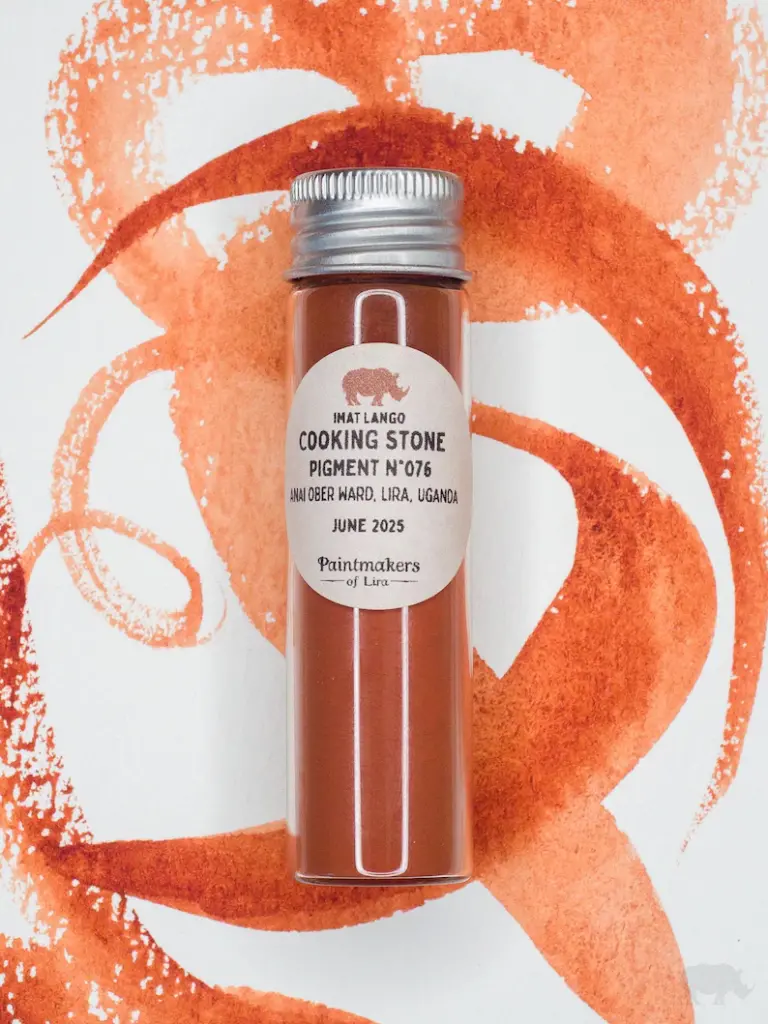
This is a deep red pigment discovered from a cooking stone that has been used for over 30 years and it holds a very beautiful story. It reflects a story that sometimes the most powerful colors are hidden in plain sight, waiting for someone to look closely.
“Imat Lango” is a word used in the Lango Tradition to show respect to women / mothers. And as a way of honoring the tradition, women had to set their fire place for cooking locally, they performed a simple ritual of setting up three heavy stones to hold pots and saucepans over the fire. These stones are more than practical tools and are termed as cooking stones. They are part of a tradition handed down through generations. When a young woman marries and moves in with her husband’s family, she is welcomed with a cooking space and a set of stones, a gesture of belonging.
Sharon’s mother still recalls how her own mother-in-law gifted her a special stone when she first joined the household. To the people of the village these are simply “cooking stones,” valued for their strength and durability, but never considered anything beyond their role at the hearth.
One afternoon, Sharon’s lifelong familiarity with these stones turned into something entirely new. She had been sitting on one of them while talking with her mother when she noticed a faint red stain on her dress. Startled and curious, she leaned closer. Could the stone itself be leaving color?
That small mark sparked an idea. Sharon asked her mother if she could take one of the stones to the paint studio. With a nod of approval, she carried it away, wondering whether this humble household object might hide a secret color.
Back in the studio she began experimenting. First, she used a hammer to break the stone apart. The outer surface, long blackened by years of smoke and flame, crumbled away. Inside, however, the rock revealed a rich, earthy red a color no one in the family had ever noticed. Excited, Sharon collected the fragments and set to work.
The result felt like more than a discovery of color. For Sharon, this pigment carried the memory of kitchens alive with conversation, of mothers and grandmothers tending fires and feeding families. It represented endurance, care, and the quiet strength of women who hold households together. To honor them, she named the pigment Imat Lango Cooking Stone Red, a tribute to her mother and to all the women who pass on tradition through the daily act of cooking.
Groundnut Black -P073
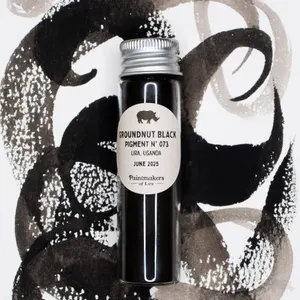
This is a carbon black pigment made from carbonized groundnut shells from groundnuts grown near the studio (groundnuts are peanuts). The pigment is very light in weight but rich and intense, and it mixes easily into paint.
Groundnuts are easily grown in Northern part of Uganda like Lira City and districts within the North they make a good snack after a long day of grinding and mulling and hauling. Pull them from the ground, wash them, then roast on fire. Some people also eat it raw without roasting. When you are done, roast the shells until black, then make pigment from them.
PLANT COLORS
Climbing Spinach/ Malabar Spinach (Atura China- D001)
After researching we discovered that the Climbing Spinach plant is in the family of vines and another name is known as the Malabar Spinach with reddish -purple stems and deep green leaves. Its common grown by home gardeners and that’s how we discovered from Robin’s nursery bed and had to also plant in our garden.
Pigment Source. (From the Fruit, Not the Leaves)
It produces small, dark purple berries which contains a strong natural pigment that can stain fingers immediately. The pigment extraction is simply collecting the ripe purple berries, crush and soak them fresh and use the deep purple juice to make a lake pigment after straining. It is good for Art projects and bright paintings. Producing strong beautiful purple however the color fades in sunlight.
Most times we collect them from Robin’s Nursery bed commonly known as Vineyard Tree Nursery Bed in Ojwina, Lira City West Division. He didn’t really have much knowledge relating to climbing spinach as a source of color.
INDIGOFERA ARRECTA- AWAE DOK (BLUE AND GREEN)- DO10
The people of Rubona in Kabarole District, western Uganda helped us identify Indigofera Arrecta. They have a practical connection to the plant rooted in their daily lives. Their cultural way of living includes weaving baskets and dyeing fabrics, the people of Rubona village specifically the Rubona basket Weavers’ Association showed us how the plant looks like. Their activities are closely tied to the land and local resources and that gave us a broad light on how to source it out within the Northern Region of Uganda. We actually had the plant in the community but people did not know its botanical name so due to the ongoing research, we discovered it.
Indigofera Arrecta grows widely in Western Region of Uganda but we also discovered this in villages across lira, Kwania and Alebtong. We always involve the local from villages within Lango Region like Agweng, Ogur, Adyaka, Ongica B, Abia among others women to harvest and help us separate the indigo leaves from the stems.
Locally, People in Lango call it “Awae Dok”,a name linked to grazing in the past. Cows used to feed on it freely in the bush, so the plant was known mainly as a cattle feed rather than a dye source.
The plant has soft pinnately compound leaves, and although the Lango community didn’t originally know its dyeing potential, the leaves produce a strong, beautiful indigo blue when processed. As we moved in the villages, we discovered that the villagers also used them as simple household brooms.
Traditional use:leaves are used in traditional medicines for treating diarrheas.
Good for: Deep, lasting blues. It’s also a great color fastness to light. Indigo is also good for laking process and as a water color but we’ve so far found it hard to make in much quantity.
Marigold Flower (Mary Jen – D011)
From the research that we conducted, Marigold flower is a bright, colorful flowering plant best known for its yellow, Orange, and golden blooms. After several counts of experimenting with it and following the laking process, we got yellow lake pigment from it.
It’s a rare flower to find but due to the curiosity we had, we never gave up on searching for the flower and we spotted the Marigold flowers in nursery beds, around churches and homes where people used it as a source of decoration. We visited nursery beds along Labourline street in Lira City. There were about three nursery beds growing marigold in small scale within Lira but when we asked them the purpose they could only say it’s a flower and that is all.
We then realized many people did not know much about plants that make colors. We explained to them our purpose for sourcing Marigold and requested them to provide us with samples. We got some and planted in our garden so that we can easily make use of it. At the moment we harvest the ones in our garden to make colors.
Shea Bark (Yen Yao – D012)
Shea Bark is both a source of brown and black depending on the mordant use in the process of making a lake pigment. The Shea tree is not so common but in few identified villages especially Abia village in Alebtong District, Lira City. We discovered some few homes in Abia, the home of Muzee Jebedeyo Ogweno grandfather to Jacob a very hardworking youth who helps harvesting the bark once we want to make the pigment.
The community has strong connection to the shea tree since it’s a source of local natural oil, they harvest the shea nuts for processing oil. Other people use the bark to cure stomach issues or skin ailments.
To extract the color It’s quite a process, we start by harvesting the bark, removing the outer hard cover, wash thoroughly since it contains high tannins that is slightly gummy and sticky. That requires rinsing it and drying it. At first, we tried making pigment out of fresh Shea Bark but that did not turn out well as a pigment since that gum affects the pigment and makes it very Sticky.
Drying the bark was a better option and when it’s dried, we Pound and crush it for proper simmering and mixing with mordants. For the case of Shea, if you want that nice brown color, we mix with Alum and Chalk. But In case you want to obtain Black color, we put a little bit of Aluminum power and iron Sulphate only.
COSMOS -ORANGE – D013
Cosmos color is a warm shade of Orange that we discovered by trying to make a lake pigment out of the orange Cosmos flowers. We first discovered Cosmos plant during a trip to Rubona in the Western part of Uganda where Sharon (Our team Lead) interacted with the Rubona Basket Weavers and she carried back some samples.
It was scarce and hard to find this side of lira so we decided to plant in our mini-garden and have it close, watered it , watched it grow, flower and make our pigment direct from our garden to the studio. The Rubona people already had a strong interaction with the Cosmos plant because they also use the dye bath for dyeing fabrics and Raffia fibers.
Morinda Lucida (Atin Kok)
Morinda Lucida is a traditional tree and its lango name is Atin Kok. It has yellow roots but it surprisingly produces a red pigment when clear steps are followed. It’s been quite a journey in locating this plant since it’s a rare species.
Sharon had been exploring plant dyes for months but had already tested a range of colors yellows from local flowers. She longed to find the source of red something truly new to her palette. Elders often carried knowledge that wasn’t written down, so she began asking for guidance.
Her father suggested visiting Mr. Owani Solomon, a young man who grew up knowing so much about the wild plants of the region. If anyone could point her toward rare dye sources, it would be him. Taking the advice, Sharon set out for Agwa in Kwania District, about 45km away from Lira City where Owani tended a small forest. Among the thickets he showed her a plant known locally as Atin Kok. Curious to learn its scientific name, Sharon opened the “Picture This” app on her phone and snapped a photo. The result flashed on her screen: Morinda Lucida one of the very species she had been searching for.
Owani explained that the plant had many uses. Its stems were strong enough to fashion into hoe handles, and the roots were prized in local medicine, believed to treat a variety of ailments including stomachaches. But we wanted the roots for a different purpose, making color, and that meant harvesting roots.
Digging for dye is no easy task. Sharon joined Owani in loosening the stubborn earth, tugging and pulling until the roots finally came free. They glowed a golden yellow, and she smiled, imagining the warm yellows they might bring to her paints. She cut and bundled them carefully, ready for the long process of preparation.
Back at the studio, Sharon set to work. First, she peeled the bark of the yellow roots and chopped the into small pieces, then pounded them to help release their natural pigments. After thorough drying, she soaked the material, strained and added a mordant to fix the dye. As the mixture steeped, she expected a sunny yellow bath.
But when she completed mixing, the color blooming was not yellow at all it was a deep, glowing red, nearly the shade of the madder roots she had worked with before. “It’s something very special, seeing yellow roots turn to red color,” she said, in amazement.
The unexpected hue felt like a gift from the tradition, she was amazed by the Special Red from Yellow Roots, but she always speaks the local name Atin Kok with respect, honoring the plant’s heritage and the guidance of the elders who led her to it.
Today, when process more of this color, we remember the heavy work of digging in Owani’s forest and the quiet wisdom of local knowledge. The color stands as a reminder that nature still holds surprises, and that what seems ordinary yellow roots in dark soil can hide extraordinary possibilities.